
The Black Sea is a semi-enclosed, brackish, non-tidal basin with a narrow connection with the world ocean through the Bosporus and the Dardanelles straits. The Bulgarian Black Sea coast accommodates three seagrass species –Zostera marina, Zostera notlii, and Ruppia maritima. All seagrass meadows are submerged as the maximum tidal range (spring tide) is within several centimetres. The coast is predominantly wave–exposed there are only few sheltered coastal stretches where wave–sensitive species, such as the above-mentioned seagrasses can thrive. One such place is the Foros Bay.
Context.
The Foros Bay lies at the innermost part of the Bulgarian Black Sea coast. It is a small, shallow bay with sandy-silty bottom, naturally surrounded by low-lying wetlands and connected with an estuarine lake, through a wetland. Historically, it was an attractive spot for human settling in the ancient times due to the beneficial combination of freshwater and fish resources, outlet to the sea, natural protection from enemies, and the favorable localization, suitable to build a fortress and a harbor. During the IX-XX centuries, the bay and the surrounding areas have been subjected to dramatic alterations with constantly increasing human impact. These include land-use modification, wetlands drainage and loss, morphological changes in rivers, the coastline, the lake-bay hydrological connection, the bay itself, and lake damming. These modifications have led to a significant change in the connectivity between the dammed and undammed parts of the lake, and between the bay and upstream wetlands. Consequently, species, habitats and ecosystem services were lost.
All of this resulted in high nutrient and suspended matter loads, entering the bay, favoring accumulation of opportunistic mat-algae (Ulva, Cladophora, Polysiphonia, Chondria, Ceramium and Callithamnion) in some parts of the bay. Historical data for seagrass distribution at this place are absent, but modeling (Hineva, 2020) has shown that naturally the bay has the potential to accommodate larger seagrass meadows than the ones that now present. The smaller observed area is primarily attributed to significant upstream human pressure.
Vision.
Despite the significant human footprint on the area, it remains a unique place, lying on the bird migratory route “Via Pontica” and offering suitable conditions for a variety of species as well as a potential for further habitat improvement. Being wave-sheltered and having a soft bottom with a small steepness, the bay offers a potential room for further seagrass spread. The long-term aim is to assist in the (re)establishment of additional 17 ha of seagrass and other submerged aquatic vegetation (Zannichellia palustris, Stuckenia pectinata.
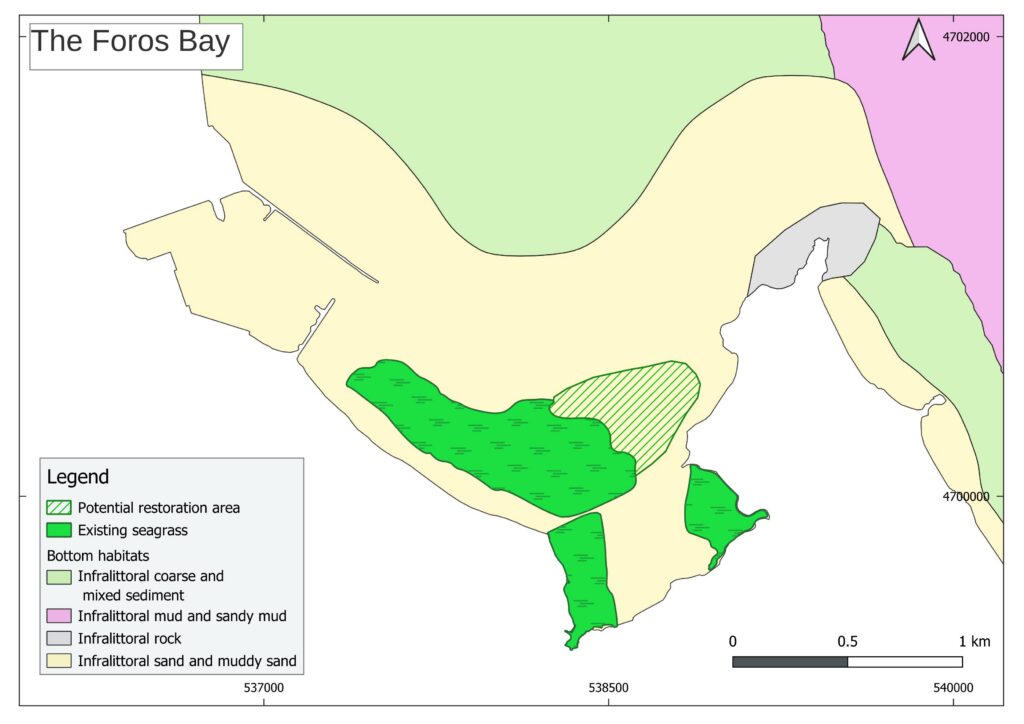
During the REST COAST project (https://rest-coast.eu/) , an experimental restoration of Zostera noltii was done to assess the applicability, organizational, and financial aspects of the sod transplantation method in the local conditions. It was applied by divers and showed good results, supporting the potential of the place for long-term seagrass restoration.
Video of the transplantation units can be viewed here:
Contact
Dr. Elitsa Hineva, e.hineva@io-bas.bg
Location
Institute of Oceanology, Bulgarian Academy of Sciences, кв. Аспарухово, ул. “Първи май” 40, ПК 152, 9000 Varna, Bulgaria